
A short clip can leave a strong impression when its subject and movement agree. For language tutors and course creators considering Highsfield, the Seedance 2.5 workflow is best approached through a brief with an observable goal. Take a fictional concept for file[https://spy.chaoniulian.com/DeeplinkBot/api/618/rss-feed/?source=RankerX&tier=T1&subCountLess=8&online=true&group=auto104] language lesson videos, designed to build a visual prompt for a simple classroom conversation. The concept works only if its intended action is clear. Rather than promising a particular generated result, this exercise explains what to ask for and how to decide whether a draft is usable.

The Highsfield homepage emphasizes a subject, a clear action and a review of supported settings. That is a useful planning framework for Seedance 2.5. The generator, rather than a guide’s headline, is where current model access and input options are shown. Confirm the available controls before committing to a particular method. A reference still or published clip can inspire a brief without establishing a promise about timing, output quality or a specific model’s capabilities.
Make the Camera Explain the Scene
Consider a fictional assignment for language tutors and course creators. Its purpose is to build a visual prompt for a simple classroom conversation. The setting is a quiet café counter with two clearly separated cups, and the required visual detail is the number of objects and the clarity of the action. Start by choosing a single action the viewer can follow. A visual prompt can support vocabulary without asking a generator to produce accurate dialogue or subtitles. Write the lesson language separately, then have a qualified speaker check the final audio and captions.
Plan where the viewer stands before choosing how the camera moves. The scene uses a stationary medium shot because the assignment is to build a visual prompt for a simple classroom conversation. A more dramatic viewpoint is useful only if it strengthens that assignment. Judge the angle by what it helps the audience understand. Keeping the camera’s role explicit also makes it easier to decide whether a later crop preserves the intended meaning.
A Seedance 2.5 Scene Brief to Evaluate
A proposed scene prompt could read: “Setting: a quiet café counter with two clearly separated cups. Action: A person places one cup beside the other. Camera: a stationary medium shot. Preserve the number of objects and the clarity of the action. Keep the background stable and end with the subject still recognizable.” This proposed prompt illustrates the assignment; it does not document a completed job. Select only input and output options the current model actually supports.
Separate subject motion from camera motion in the brief. In this scene, a person places one cup beside the other, while the view uses a stationary medium shot. Those instructions should not quietly become two unrelated actions. State what stays fixed as clearly as what moves. The distinction is particularly useful when a reference image already establishes the object’s appearance but says nothing about how the shot should progress or where it should end.
Keep subject movement and camera travel from working against each other. If the audience needs to inspect the number of objects and the clarity of the action, a rapid viewpoint change may hide it. A modest move can reveal more than a complicated orbit. State the desired direction and endpoint in the brief, then leave room for a review of whether the result maintains useful subject scale instead of unexpectedly enlarging or losing the subject.
Study Published Images and Video Examples
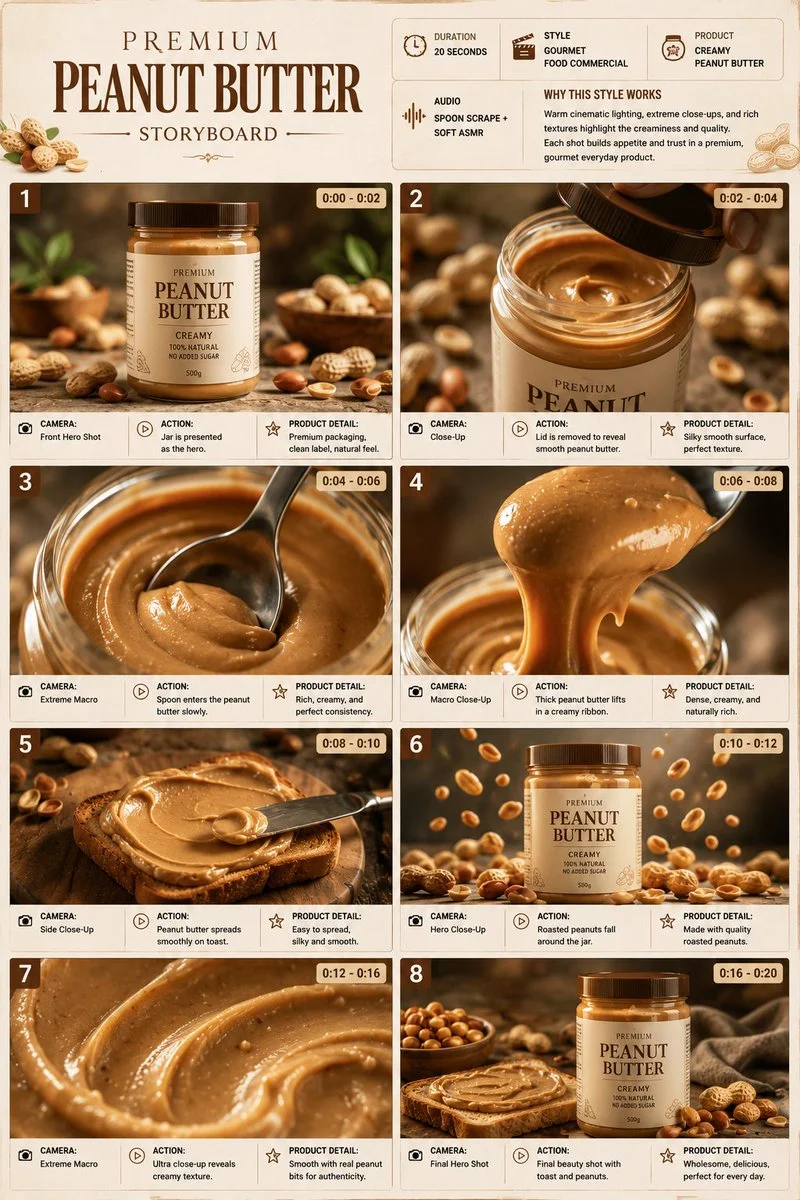
The published image shows a peanut-butter storyboard with several planned compositions. It is useful for studying the difference between a planning sequence and a finished motion result. The reference supplies a composition, not an automatic motion instruction. Use that distinction when planning the proposed scene. This is a reference from the public site, not a newly generated result or proof of Seedance 2.5 performance.
The video poster shows a light-colored sneaker on a dark plinth. Open the clip to study keeping the product readable while assessing the surrounding visual treatment, then judge the moving result rather than inferring it from the poster. Its use here is as a visual reference; this article does not attribute the clip to Seedance 2.5. Compare the opening and ending before borrowing a camera idea. The proposed project remains a separate, hypothetical exercise.
Check the Clip Against the Actual Assignment
For this particular concept, check that students can name the action without guessing. Reject the draft if objects change number or the hands become unreadable. That is a visible requirement rather than a general preference for a polished look. If the mismatch appears in only part of the clip, identify that moment before changing the brief. An acceptable opening frame does not excuse a subject or environment that becomes inaccurate during the intended action.
Review the clip at normal speed before examining individual frames. The first pass asks whether the action is understandable; the second looks for instability in the number of objects and the clarity of the action. A pause can reveal a defect that motion conceals. Compare the opening, a middle moment and the ending, then examine any transition that looks wrong. Do not let an attractive thumbnail stand in for a review of the actual moving result.
Review the camera path separately from the subject’s action. First ask whether the view stays at a useful distance; then check whether the action happens as intended. Two separate checks help identify the source of the mismatch. If the subject is accurate but the view drifts, revise the camera direction. If the view works but the number of objects and the clarity of the action changes, keep the framing and correct the appearance or action instruction.
Complete the Highsfield Workflow Carefully
Before a generation request, review the model, accepted inputs, duration, framing and credit estimate actually shown by Highsfield. Choose only available settings. A larger file is not automatically a more accurate scene. If Seedance 2.5 is not accepting requests in the current interface, retain the plan and use a suitable available workflow only after checking its own options. This article does not establish a fixed price, processing time or output specification.
A handoff needs more than a video file. State the destination, intended message, source permissions and any detail that must stay visible. In this exercise, test the chosen view in the intended crop and preserve the important detail through the edit. A short production note can prevent an avoidable recrop. If the published asset is an illustration or concept, keep that status understandable. Do not turn a planning study into an apparent product test, customer testimonial or record of a real event.
The strongest outcome from this exercise is a repeatable decision process. language tutors and course creators should be able to explain why the shot exists, what the subject does and how a draft is reviewed. Highsfield’s Seedance 2.5 workflow gives the planning a practical setting, while the live controls establish the available options. Move forward when the scene meets its purpose, and keep the result attached to the original prompt rather than treating a lucky visual as a method.